

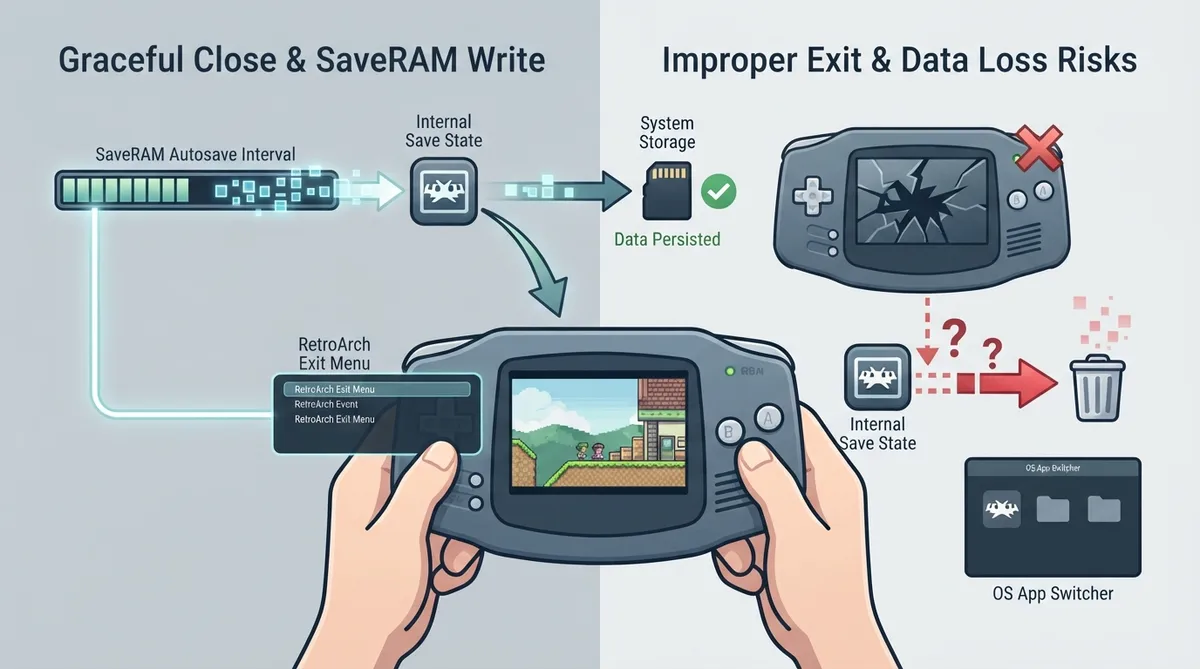
The official RetroArch documentation page for Nintendo Game Boy Advance core compatibility centers on one practical issue: in-game save data. It notes that only certain cores support the libretro save interface, so the SaveRAM Autosave Interval setting does not behave the same way across all GBA cores.
Why the autosave setting matters
The SaveRAM Autosave Interval option is meant to write save data periodically. According to the documentation, however, some cores write internal save game data only when emulation is closed gracefully. That means the setting alone does not guarantee that save data is written while you are still playing.
Autosave support by core
- The documentation distinguishes GBA cores by whether they support the SaveRAM Autosave Interval setting:
- Cores the page lists as supporting the SaveRAM Autosave Interval: mGBA, VBA-M, and VBA Next.
What this means in practice
For cores that rely on a graceful close to write internal save data, exit emulation through RetroArch's own close process rather than killing the app from the OS app switcher. This reduces the chance that in-progress save data is never written.
Reference table · Scroll horizontally to see all columns.
| GBA Core | SaveRAM Autosave Interval |
|---|---|
| mGBA | Supported |
| VBA-M | Supported |
| VBA Next | Supported |
Sources & references
Content responsibility: FrameTinker editorial desk. Source authors and software maintainers are credited separately below; this is not a claim of hands-on testing.
Published .
RetroArch: gba — official gaming software documentation https://raw.githubusercontent.com/libretro/docs/master/docs/library/compatibility/gba.mdRetrieved Oct 17, 2026Something doesn’t match your setup?
Suggest a correction