

What the Blurs Documentation Covers
The official libretro shader documentation describes the Blurs category as shaders that use low-pass algorithms to remove high-frequency data and blur the image. The page then lists several blur shader families, including types that ship with presets and a set of shaders that do not have presets.
Blur Types Documented With Presets
Gaussian Blur
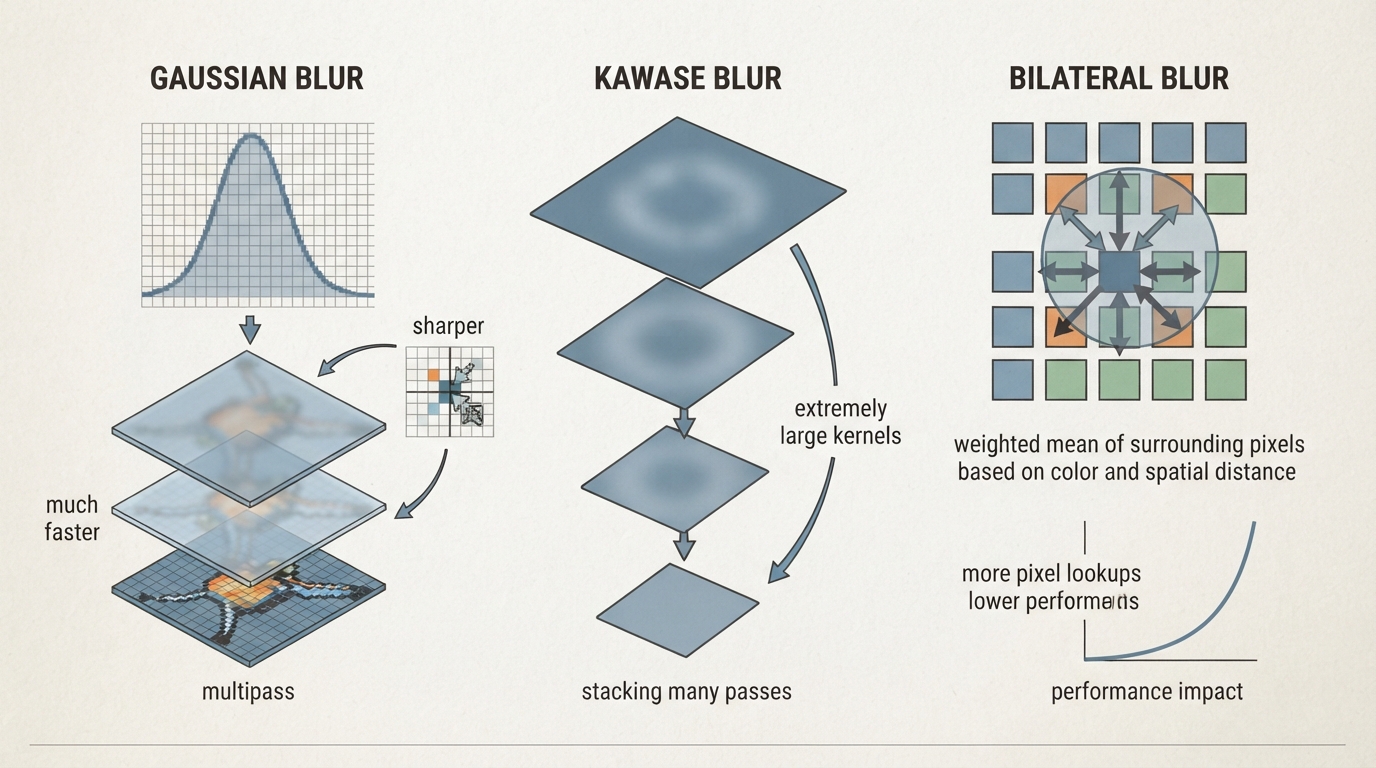
The documentation describes Gaussian Blur as a basic implementation of Gaussian blur that is available in single-pass, multipass and sharper flavors. It notes that the multipass version is much faster.
Kawase Blur
Kawase Blur is presented as a method for making very fast, high-quality blurs with extremely large kernels by stacking many passes of a simple blur.
Shaders Without Presets
Bilateral
According to the documentation, Bilateral calculates a weighted mean of surrounding pixels based on color and spatial distance. The page says this can be used to smooth color transitions or blend dithering to some extent while preserving sharp edges. It also notes that increasing the radius leads to more pixel lookups and therefore to lower shader performance.
Smart-Blur
Smart-Blur is described as blurring pixels selectively based on the absolute difference from the neighboring pixels per color channel. The documentation compares it to bilateral filtering.
BlurX
The page lists BlurX with variants including separable, YxY, fast, resize and gamma. It describes this as a huge collection of blurs written by Trogglemonkey, the author of CRT-Royale, covering a wide variety of kernel sizes and gamma configurations for many different use-cases.
Blur-Gauss-H/V
Blur-Gauss-H/V is described as a separable, two-pass implementation based on the article "Efficient Gaussian blur with linear sampling" from rastergrid.com.
What the Source Document Does Not Specify
The documentation page is a descriptive list of blur shader types. It does not lay out prerequisites, installation or configuration steps, version or platform compatibility, or specific parameter tuning instructions. Those details are not covered in the material summarized here.
Sources & references
Content responsibility: FrameTinker editorial desk. Source authors and software maintainers are credited separately below; this is not a claim of hands-on testing.
Published .
RetroArch: blurs — official gaming software documentation https://raw.githubusercontent.com/libretro/docs/master/docs/shader/blurs.mdRetrieved Oct 14, 2026Something doesn’t match your setup?
Suggest a correction